
Combien coûte un présentoir à carrelage?
A tile display rack is the fixture a showroom, distributor, or tile store uses to present tile, stone, and flooring samples to customers, whether that’s a small countertop stand, a wall of hanging panels, a sliding bay, or a sample book handed across the counter. There is no single price for one. A countertop unit might run $30. A custom floor-to-ceiling showroom system for a flagship store can pass $8,000. Most retailers I work with spend between $200 and $2,000 per fixture, and the number that matters isn’t just the sticker price, it’s what the rack has to hold and where it has to live.
The mistake people make is asking “what’s the cheapest rack” when they should be asking “what does this rack cost me over the five years I’ll use it.” A $90 sample book you replace every season is not cheaper than a $900 sliding bay that lasts a decade. Let’s walk through the real numbers, what moves them, and how to get a quote that’s actually accurate instead of a guess.
The short answer: what to budget by rack type
These are ballpark factory prices (FOB) for a standard, off-the-shelf rack from a manufacturer like us. Your number will move based on size, material, finish, and quantity, but this gives you a starting point.
| Rack type | Ballpark price | Holds roughly | Best for |
|---|---|---|---|
| Countertop stand | $25–$90 | 20–60 tiles | Small shops, impulse displays |
| Sample book / booklet | $8–$40 | 10–30 samples | Sales reps, trade shows, mailers |
| Sample suitcase | $45–$150 | 30–80 samples | On-the-go sales calls |
| Waterfall wall rack | $150–$600 | 60–150 tiles | Showroom centerpiece |
| Sliding rack | $300–$1,500 | 100–400 tiles | Large catalogs, distributors |
| Push-pull rack | $400–$2,000 | 120–500 tiles | Heavy large-format tiles |
| Rotating rack | $300–$1,200 | 80–200 tiles | Corners, high-traffic browsing |
| Large slab A-frame / cart | $500–$2,500 | 10–40 slabs | Stone yards, slab showrooms |
| Full custom showroom system | $1,500–$8,000+ | Hundreds | Flagship stores, franchise rollouts |
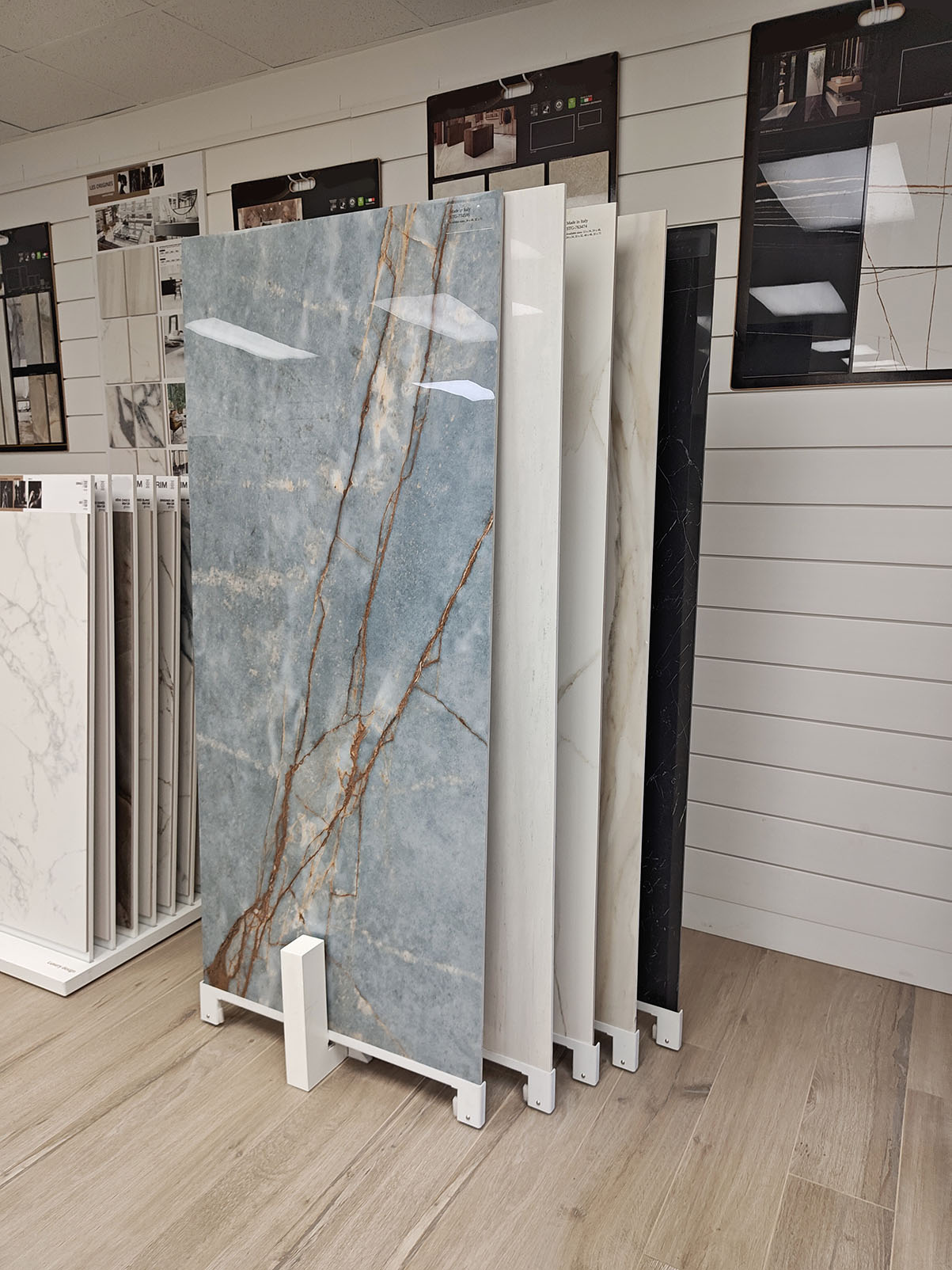
What actually drives the price
Two racks that look similar can differ in cost by a factor of five. Here’s where the money goes.
Does the material change the cost?
Yes, and it’s the biggest single lever. MDF is the cheapest base; it’s flat, stable, and takes paint well, which is why most entry-level racks use it. Plywood costs more but holds screws and hinges better under repeated use. Metal and aluminum cost the most and show up on racks built to carry heavy slabs or survive constant handling. Wood veneer finishes sit on top of any of these and add cost, because the veneer itself is a premium material and the application is slower.
Does size and capacity matter?
A rack that holds 300 tiles needs more panels, more hardware, and more labor than one that holds 50. Capacity is the most honest way to compare two racks: price per sample slot, not price per rack. A $400 rack holding 200 tiles costs $2 a slot. A $90 stand holding 40 costs $2.25 a slot. The bigger unit is often the better deal per sample, even though the total is higher.
Does the finish change the price?
Painted MDF is cheapest. Laminate adds a durable, cleanable surface and an extra production step. Real wood veneer is the most expensive and the most “showroom” looking. If your display sits next to $80-a-square-foot marble slabs, veneer is worth it. If it’s a working sample bay in a distributor’s warehouse, paint is fine and you’ll save real money.
Does hardware matter?
This is where cheap racks show their age first. Soft-close slides, ball-bearing rollers, and quality hinges cost more up front but are the difference between a rack that glides after five years and one that sticks after six months. If customers will be pulling panels open and shut all day, don’t skimp here.
How much does customization add?
Custom sizing, your logo, brand colors, or slots cut for a specific tile size all add cost. A fully custom rack typically runs 30% to 100% over the equivalent stock unit, and it usually comes with a minimum order quantity (MOQ), since the factory sets up tooling for your spec. The tradeoff is a fixture that fits your space exactly and carries your brand. For a single one-off rack, custom can be expensive; for a franchise rolling out 50 identical stores, custom is often the cheaper per-unit option.
Does quantity change the price?
More than anything else. Ordering one rack means paying for setup, sourcing, and a production run of one. Ordering fifty spreads that setup across fifty units. Bulk discounts on tile display racks commonly run 10% to 30% below single-unit pricing, and freight per unit drops too. If you have multiple showrooms or a franchise network, batch your orders.
The costs nobody puts on the invoice
The rack price is only part of what you’ll spend. These are the ones that catch first-time buyers off guard.
How much does shipping add?
Freight is the hidden cost that stings the most, especially if you’re importing. A single rack shipped internationally can add 30% to 60% on top of the unit price once you factor in crating, ocean or air freight, customs, and last-mile delivery. Racks that ship flat-packed cost far less to freight than assembled ones because they take a fraction of the volume. That’s a big reason flat-pack designs dominate the import market.
What about assembly and sample mounting?
A flat-pack rack still has to be built, and your tiles still have to be mounted onto it. Assembly labor is usually minor for a simple stand but adds up on a multi-bay wall. Mounting samples is the quieter cost: each tile has to be attached, aligned, and labeled. Budget for the labor, not just the fixture.
Does a custom rack come with a setup or mold fee?
Sometimes. If your rack needs new tooling (a custom extrusion, a non-standard slot size, a molded component), there can be a one-time setup fee on top of the unit price. That fee usually amortizes to nothing across a large order, which is another reason custom makes more sense in volume.
Custom vs stock: which is actually cheaper?
For a single rack, stock wins on price every time. For a large or repeated order, custom often wins on value. Here’s the comparison.
| Stock rack | Custom rack | |
|---|---|---|
| Unit price | Lower | 30–100% higher |
| Setup / tooling | Usually none | Possible one-time fee |
| Lead time | Days to weeks | Weeks to months |
| Fit to your tiles | Approximate | Exact |
| Branding | None or limited | Full |
| Per-unit cost at scale | Stays flat | Drops sharply |
The rule I give retailers: if you need one rack now, buy stock. If you’re building out three or more locations or standardizing your showrooms, get custom quotes and compare the landed cost per unit across the full order.
How to get a quote that’s actually accurate
The fastest way to a real number is to stop asking “how much is a tile display rack” and start sending specs. A manufacturer can quote a vague request, but the number will be a wide range with a lot of “depends.” Send these five things and the quote tightens up:
- The tile sizes, thicknesses, and weights you need to display
- How many SKUs and how many samples per SKU
- Your showroom dimensions or available wall/floor space
- Preferred material and finish (MDF, plywood, metal, veneer)
- Order quantity and target budget
If you’re unsure on material or capacity, send what you know and ask the manufacturer to recommend. We quote off a drawing and a spec sheet, so the more detail you give, the closer the first number is to the final invoice.